
Mike Worthington
August 2026
I’m not talking interior hotel lobby design. I’m talking how are the marginalised received in our society and what can architecture do about it.
The Cambridge Dictionary defines Hospitality as: ‘the act of being friendly and welcoming to guests and visitor’
Hospitality is derived from the Latin ‘hospes’ meaning host, guest, or stranger and so is concerned with the social interaction, reception and relationship of all three.
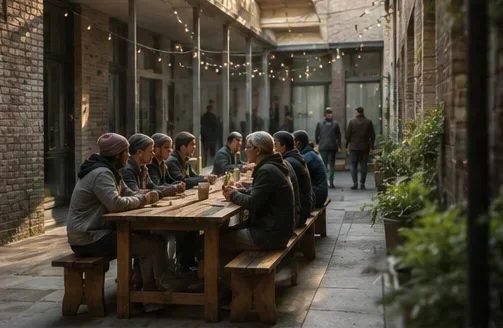
So, what role can architecture play in hospitality? It may not have easy answers, but we are exploring where architecture serving people and we feel architecture must not be ambivalent in real hospitality as it frames relationships.
.
Cultures
Hospitality varies across cultures and situations where expectations may place different requirements on the host or rules for the guest. In warmer climates the home is more open and informal with spontaneous hospitality expectations. Whereas, in colder climates with an individualism mentality, hospitality might be more formalised and organised.
In Albania, traditional custom places honour at the centre of hospitality. This law is summarised in the Kanun ‘The house of the Albanian belongs to God and the guest’.
This places the guest above the master of the house and treating the guest or the stranger as a semi-god. The phrase we are more familiar with in the West is ‘blood is thicker than water’. Albanian hospitality pushes beyond the nationalistic sentiment of ‘my people first’, granting elevated status to the stranger.
Similarly, in India and Nepal the principle Atithi Devo Bhava, meaning ‘the guest is God’ leads to an Indian or Nepalese practice of graciousness towards guests at home and in all social situations.
Anecdotally, it appears that every season of Race Across the World demonstrates a variety of UK couples or friends traversing the globe on a shoestring, forced to rely on others rather than themselves. They are consistently surprised by the hospitality shown to them by those from other cultures with demonstrably less than they have. These moments of relationship and hospitality are often the most moving, rich and joyful experiences of their trips.
The Good Samaritan parable in the Christian Bible is intentionally shocking to its original Jewish audience because it describes the radical care and hospitality offered not within a singular community but across community barriers where the expectation was enmity not hospitality. The parable asks the question ‘who is my neighbour’? This in turn asks us the question who do we live in relationship with across our communities?
On the other hand, many cultures seem to express the same sentiment as the Nigerian proverb ‘A person is a guest for one or two days, but becomes an intruder on the third’, at least acknowledging the tension experienced within hospitality!

Independent Loneliness
We are familiar with the idea of loneliness that comes from the most populated cities where the sheer scale creates anonymity. This reduces interdependent relationships, sense of community and the accountability of being known within your community.
Most of us are drawn to the idea of community whilst also seeking control, independence, personal space with an element of commitment phobia that often pushes against the longer-term relationships that mark healthy community. This tension between community and independence is manifests itself in our relationships and our view of hospitality.
Accepting hospitality creates vulnerability for the guest as it suggests reliance on others which can hurt pride or perhaps sets an expectation or obligation to return the favour. True hospitality though perhaps requires a willingness to both give and receive, but critically is a gift given without expectation of reciprocity. The Moroccan proverb says ‘The guest doesn’t place conditions, and the host doesn’t neglect’.
In our society we seem increasingly identified in our political view by how our tribe responds to others who are different and gravitate either towards homogeneity or diversity. Is a healthy society formed from more singular cultures with their own boundaries operating independently, or from a multicultural society where widely different cultures are intermingled?
Burnham’s Homelessness pledge
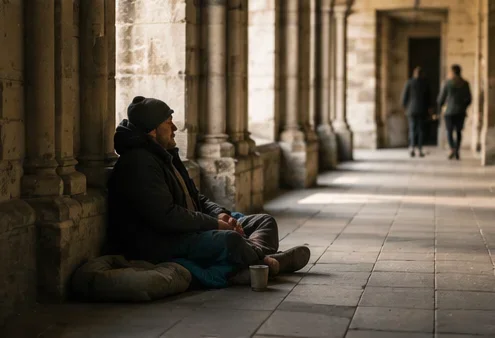
As I write one of Andy Burnham’s first acts last week as the UK Prime Minister was to pledge an end to Homelessness, ‘Now is our chance to end rough sleeping’.
Not a trivial undertaking, but this asks the question of our society as to how we are hospitable to the marginalised or strangers in our midst. Do we have a societal obligation to look out for all, or is it every individual for themselves?
There are of course already many national and local organisations working hard on this area to bring immediate care and investment into the solving the challenge of homelessness. ‘Hope into Action’ in Southampton empowers churches with a franchise model pairing residential properties with local churches across all denominations.
Similarly, church buildings across the country in partnership with local council offerings are used especially in the winter to create warm spaces and hot food where rough sleepers are at their most vulnerable to the elements.
Hosting the Community
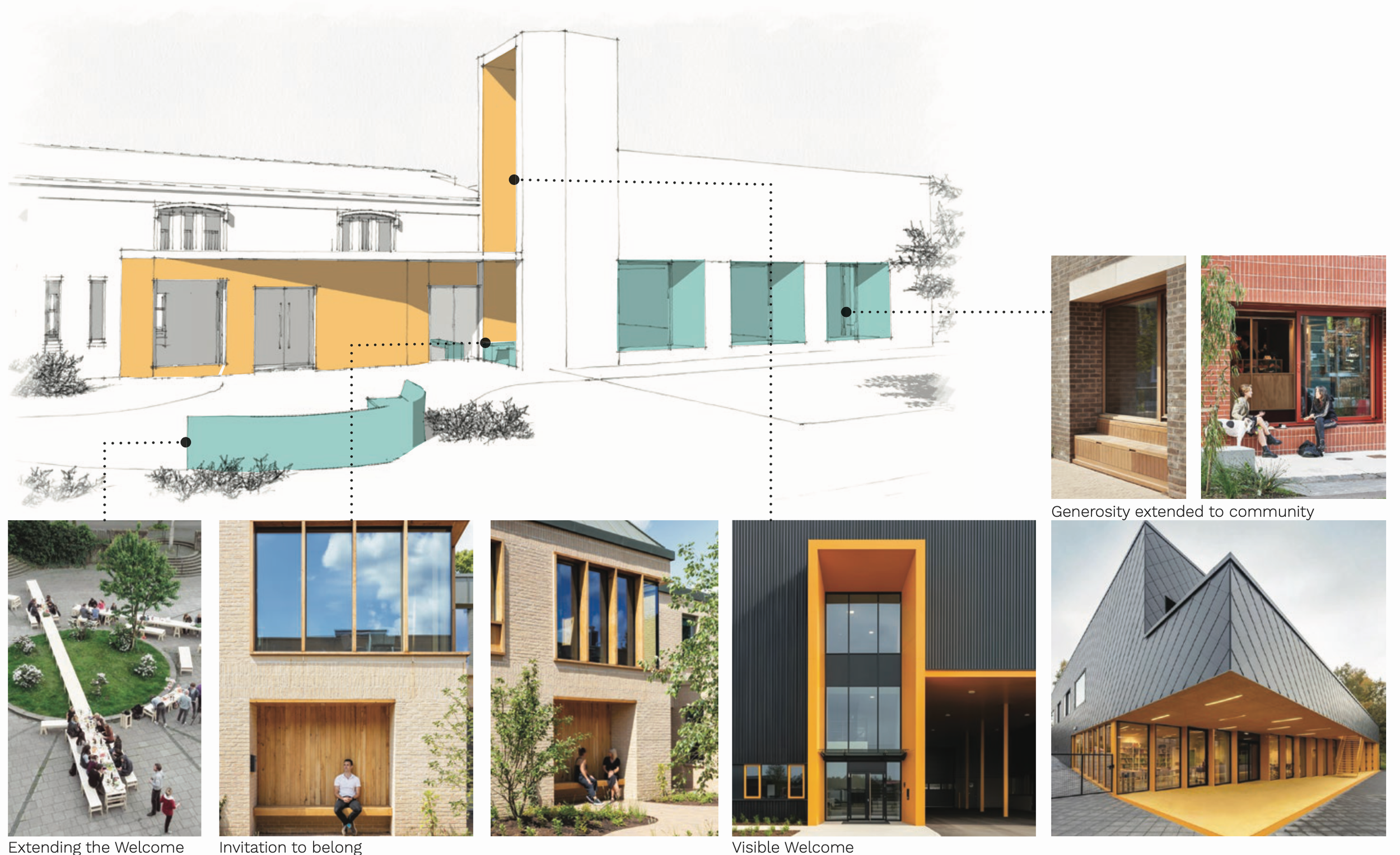
A recent People Architects project explored the question of architectural hospitality for a church. The brief was to expand the interior space to meet the needs of those, inside whilst the heart of the church was to meet the needs of the community on the outside (as well as its own congregation).
For us this is the exciting intersection of how architecture seeks to frame relationships. The church is in the centre of a poorer community developed in the late 20th Century after the advent of the car and without a historical centre. A permissive path passes through the church grounds between the church and the public library. We asked the question ‘what would it look like for the church architecture to embody serving its community’?
The location and permissive path presents the church with the opportunity to host the community on its grounds defining a community centre. Reorientating its frontage to create relationship with the guest and stranger at and across the building edge.
Hosting explores how people are welcomed to sit, sleep, eat, slow down and engage with each other and the church. This is the antithesis of hostile architecture seeking to move people on, exclude and prevent occupation.
Interestingly this has awakened my MArch Part 2 thesis ‘Inhabiting the edge: human interaction at the interstitial edge’.
Restorative Community Justice
Through the design of Hope Street for One Small Thing as a trauma informed community alternative for women and their children in the justice sector, there was the opportunity to explore the language of architectural hospitality.
Through lived experience consultations of women who had experienced prison, temporary accommodation and unsafe home environments we defined architectural questions as ‘What would it look like to create a home rather than an institution’? This saw architecture as a tool to express a friendly welcome from the host to the stranger in order that they may be received as a valued guest.
The architectural language communicates hospitality to the women who become guests and reminding the host of their culture of hospitality. Through architectural expression it also communicates to the local community a response and tone to the stranger. Had the tone of the relationship been expressed as distrust, fear and dehumanisation then this would have led the local community in their thinking.
I was in Albania earlier this year at the RESCALED Symposium. They are a European organisation who strongly believe that society and individuals do not benefit from large scale impersonal prisons. They propose restorative justice through community detention houses where we hold the tension of safety and community rehabilitation together as a mixed society.
This places the focus on working through relationships when they go wrong, leaving the opportunity for reintegration rather than writing off the possibility of rehabilitation.
Seeking Refuge
This tension of navigating difficult relationships and conflict within a mixed community rather than retreating into silos of homogeneity has struck me over the last few months. The desire we see for community and a sense of belonging and connection to others is tested when the relationships are wronged or when there is misunderstanding or fear of the unknown.
Remaining within, being invested and collectively accountable in the tension, seems to be a necessary requirement to receive the benefits of a healthy community.
Having explored the idea of architectural hospitality through the Hope Street project we have recently been in discussion to transpose some of these ideas into the context of accommodation for refugees and asylum seekers. This is a section of our society that is possibly the biggest political football and rife with fear and misunderstanding. On the one hand there are demonstrators protesting outside hotel accommodation and on the other side of the road are often counter protests and organisations who feel strongly in support of the plight of asylum seekers and refugees.
Without entering the political debate on numbers or systems for deciding applications, how we treat the stranger arriving on our shores with nothing, is the essence of the questions of our societal response to hospitality. There is no immediate benefit or transaction but offering refuge is an act of charity toward those in need. Our response is at the sharp end of our views on homogeneity or a mixed cultural society.
Thin Places
One of the conclusions arising from our exercise was that to achieve the objective of social integration for those granted asylum as refugees, we would need to find the thin places of hospitality. Where in our communities can we accommodate asylum seekers and refugees where relationships, cultural learning and community can be built?
Can we create local host communities as centres of hospitality where the stranger is received as a guest?
There are many charities and faith groups who are actively trying to support asylum seekers through the traumatic experiences of war and abuse that led to them to fleeing their home country. They also seek to support practical needs, of shelter, food and English language classes as well as the relational need for human interaction.
One solution is to explore partnerships with the sometimes asset rich, if not liquid rich church. Some church buildings are either vacant, requiring repair and renovation or are underutilised. They are usually present within our communities, near local services and often have a culture and belief in hospitality.
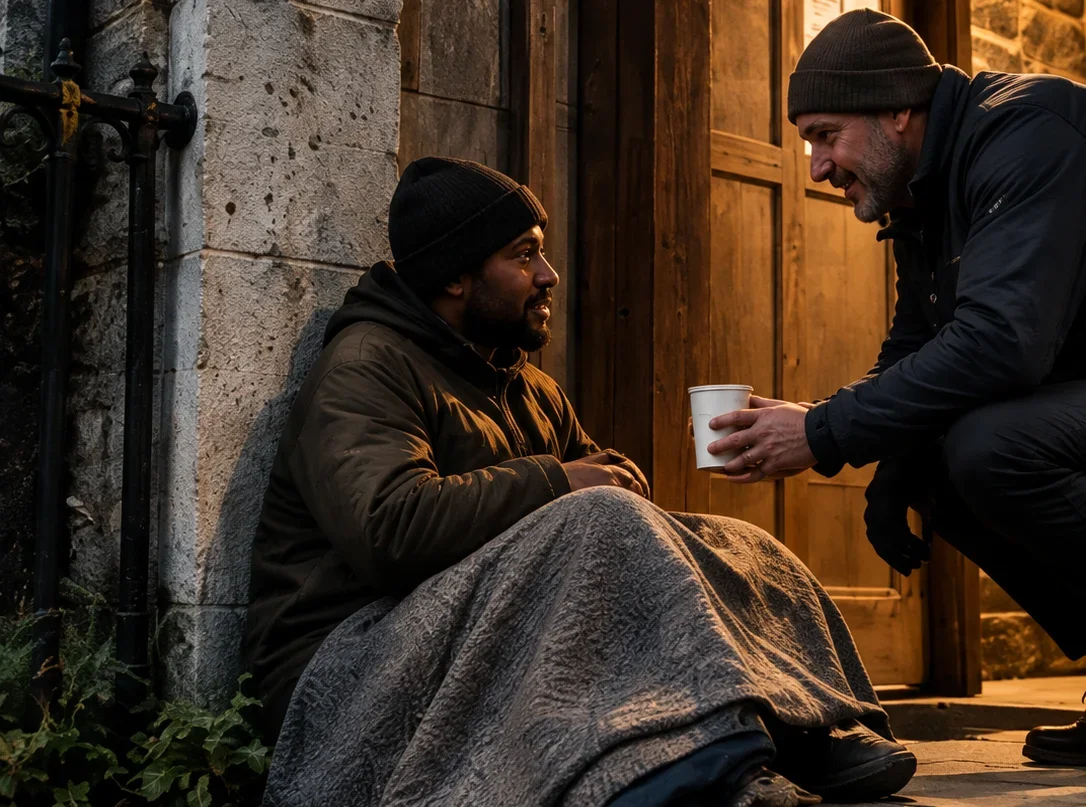
At a local church in Southampton the vicar offers the side porch of the church for homeless rough sleepers to have a place where they are received and welcomed rather than moved on. This represents the heart of hospitality to the stranger but there are further step towards using our buildings for hospitality.
We need greater imagination in Architectural Hospitality for how we behave as the radical Good Samaritan community to host the stranger as a guest. Architecture must occupy and frame positive relationships in the thin places.